
Generative design reaches whole organisms

-
Nº LXXII
- Date
- 07 Aug 2026
- Issue
- 72
- Stories
- Seven
- Editor
- ARC
Today the design frontier jumped from single proteins to whole viruses, and the screening literature is already scrambling to catch up.
AI designs a virus from scratch

Generative AI designed a virus with no natural counterpart, per a Stanford-led team, in what Axios calls the first use of AI to create an organism never seen in nature. The stated aim is therapeutic: engineered viruses that attack bacteria. But the same loop that yields phage therapy yields pathogens, and Axios puts the dual-use case bluntly, citing long-standing warnings that designed agents could outrun the surveillance systems meant to catch them. The capability frontier moved from designing single proteins to designing whole replicating agents, which is a different order of therapeutic reach and a different order of containment problem.
TERRA builds a tissue world model
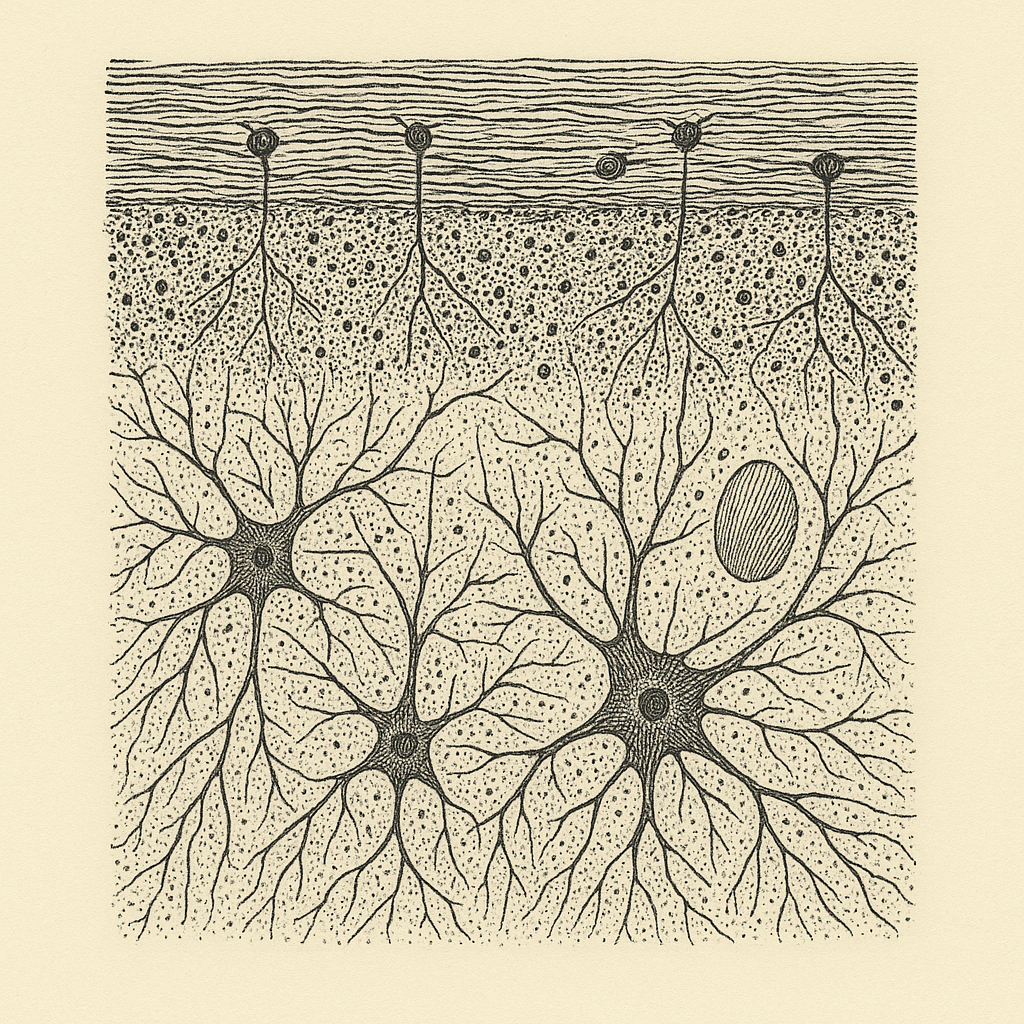
TERRA models human tissue as a world model (a model trained to predict how a system changes rather than to label individual samples), pretrained on 112 million cells of spatial transcriptomics. Mo Lotfollahi's group describes roughly 18 months of paired data generation and modeling to get there. Scale like that carries foundation-model work in biology past single cells and into tissue context, where spatial arrangement holds most of the signal a pathologist or clinician actually reads.

Hassabis moves off DeepMind CEO role
Demis Hassabis is stepping down as CEO of Google DeepMind after 16 years, taking the Chairman and Chief Scientist roles in a major reorg. The shift puts him closer to research and further from operations at the institution behind AlphaFold and Isomorphic Labs. Leadership continuity at DeepMind has been one of the few stable assumptions in bio-AI planning, and whoever runs the day-to-day now sets how much of that compute points at biology.
Screening moves to the design request
Input screening proposed for protein design tools in a new bioRxiv preprint, arguing the safety check belongs at the design request rather than downstream of the generated sequence. It lands beside the AI-designed virus above, shifting biosecurity attention from sequence databases toward the design interface itself.
EpiBench scores epitope reasoning
EpiBench tests whether large language models can reason about epitopes for antibody drug discovery. It gives epitope understanding a reference score, in an area where general-purpose models have been assumed competent without anyone measuring it.
Pathology model reads whole slides
Whole-slide attention carries a multi-modal foundation model to single-cell resolution in digital pathology, with performance the authors report as transferable across tasks. That pushes pathology models past patch-by-patch tiling toward slide-scale context, the level at which diagnoses actually get made.
Hospital agents get a compliance layer
Compliance-first agentic architecture for hospital AI arrives on arXiv, layering governance and audit into the system design instead of bolting it around siloed algorithms. Makes regulatory fit an architecture question for clinical agents rather than a deployment afterthought.
Reply with your discoveries. A human reads them. Forward freely.
|