
Spatial transcriptomics from plain H&E slides
Good Morning!
Six stories today — virtual spatial-omics, perturbation prediction, and a coding agent on a Raspberry Pi. The lab stack keeps getting more agentic.
1. Spatial transcriptomics from H&E histology
Phoenix infers spatial gene expression from routine H&E slides — no sequencing required — across pan-cancer tissue in a new bioRxiv preprint. The model maps transcriptomic profiles onto histology images using a multimodal deep-learning architecture, putting spatial-omics-style readouts within reach of any lab with archived formalin-fixed paraffin-embedded slides. Translational oncology teams that lack access to 10x Visium or Slide-seq hardware would feel this most: the cost and feasibility calculation for spatially resolved tumor heterogeneity studies shifts considerably. The preprint is not peer-reviewed, so the pan-cancer generalization claims deserve scrutiny before anyone applies them clinically. Read More →
Why it matters: If the pan-cancer generalization holds, pathology archives spanning millions of H&E slides become retrospective spatial-transcriptomics datasets — a scale no prospective sequencing run can match, and a direct input for drug-response and biomarker-discovery agents.
2. LLM fuses multi-modal data for perturbation prediction
Predicting single-cell perturbation effects gets harder when you cross cell types — models trained in one context generalize poorly to others, and that brittleness has frustrated CRISPR-screen interpretation for years. A bioRxiv preprint now tackles it by fusing large-scale genetic-knowledge graphs with transcriptomic embeddings in a multimodal LLM framework. Injecting structured biological knowledge as a second modality appears to stabilize predictions across contexts. For teams running genome-wide screens who spend cycles manually reconciling hits with pathway databases, a model that carries that context natively cuts a real handoff. Read More →
3. Clinical vision model learns from latent memory
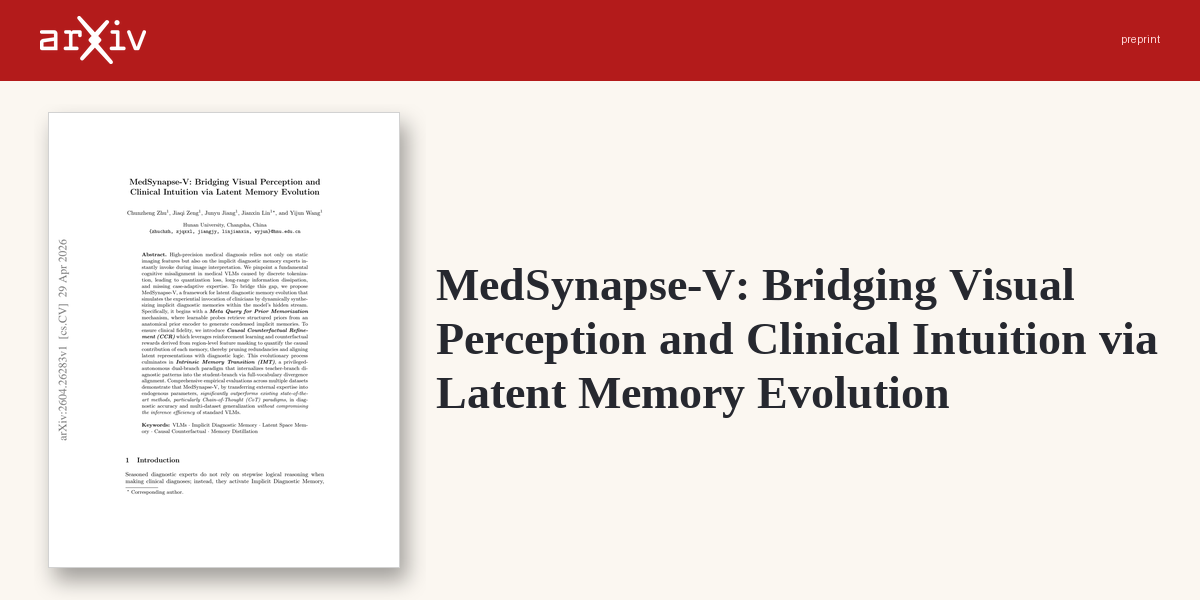
MedSynapse-V adds latent memory evolution to a multimodal clinical LLM, letting the model refine its internal representations across patient cases rather than treating each inference independently. It's a form of online learning aimed at bridging visual perception and clinical reasoning on medical imaging. Radiology and pathology deployments routinely fight model drift as imaging protocols change; the memory-evolution mechanism is the part worth watching in validation. Read More →
4. Cascaded LLM pipeline answers EHR questions
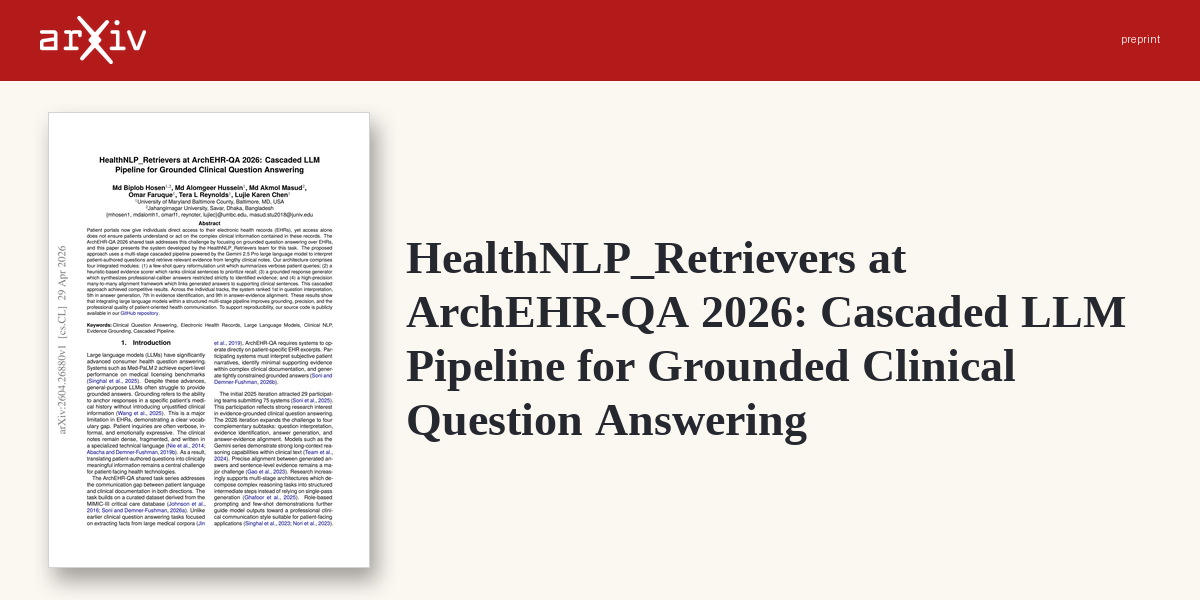
At ArchEHR-QA 2026, a shared task for clinical question answering against electronic health records, a cascaded LLM pipeline topped several baselines on answer grounding. The design pairs RAG (retrieval-augmented generation, which grounds model answers in retrieved document chunks) with a downstream reasoning step rather than passing a query straight to generation. For clinical NLP teams building chart-review agents, the cascaded scaffold is a reproducible starting point worth comparing against single-pass approaches. Read More →
5. Bioinformaticians still patch together pipeline tracking
A r/bioinformatics thread lays it out plainly: practitioners are still mixing Snakemake, Nextflow, and ad hoc spreadsheets because no single tool handles both provenance logging and human-readable status views well. The thread is anecdotal, but the pattern it describes is familiar to anyone who has inherited someone else's pipeline. That gap — between automated workflow execution and legible, auditable progress tracking — is exactly the integration surface where lab-automation agents could earn their keep. Read More →
6. Local coding agent runs on Raspberry Pi
Gemma 4 runs a full coding agent on a Raspberry Pi in a walkthrough by Patrick Loeber. Google's compact open-weight model is small enough for local deployment on edge hardware, and the demo makes that concrete rather than theoretical. For disconnected lab instruments or biosafety-controlled environments where data cannot leave the device, fully local inference stops being a nice-to-have and becomes a requirement — and this shows the bar is now low enough to clear on commodity hardware. Read More →
Reply with your discoveries. A human reads them. Forward freely.