
Benchmarks end where drug discovery begins

-
Nº CXV
- Date
- 07 Oct 2026
- Issue
- 115
- Stories
- Four
- Editor
- ARC
Four papers, one question: what happens when an agent leaves the benchmark and meets an actual project.
Preprint tests if AI agents survive real drug discovery

Drug-discovery agents stress-tested against live project work rather than curated benchmark tasks, in a bioRxiv preprint asking whether today's LLM agents — software that plans and executes multi-step work on its own — hold up once the task isn't a tidy eval item. Agent claims in this space have run almost entirely on benchmark scores, and benchmarks reward the subset of problems someone could package: clean inputs, known answers, one correct path. Real medicinal-chemistry programs supply none of that. P. Llompart's framing shifts the evaluation question from what an agent scores to what it finishes, and raises the bar for what counts as evidence that an agent works in discovery at all.
Language models design phosphatases aimed at new targets
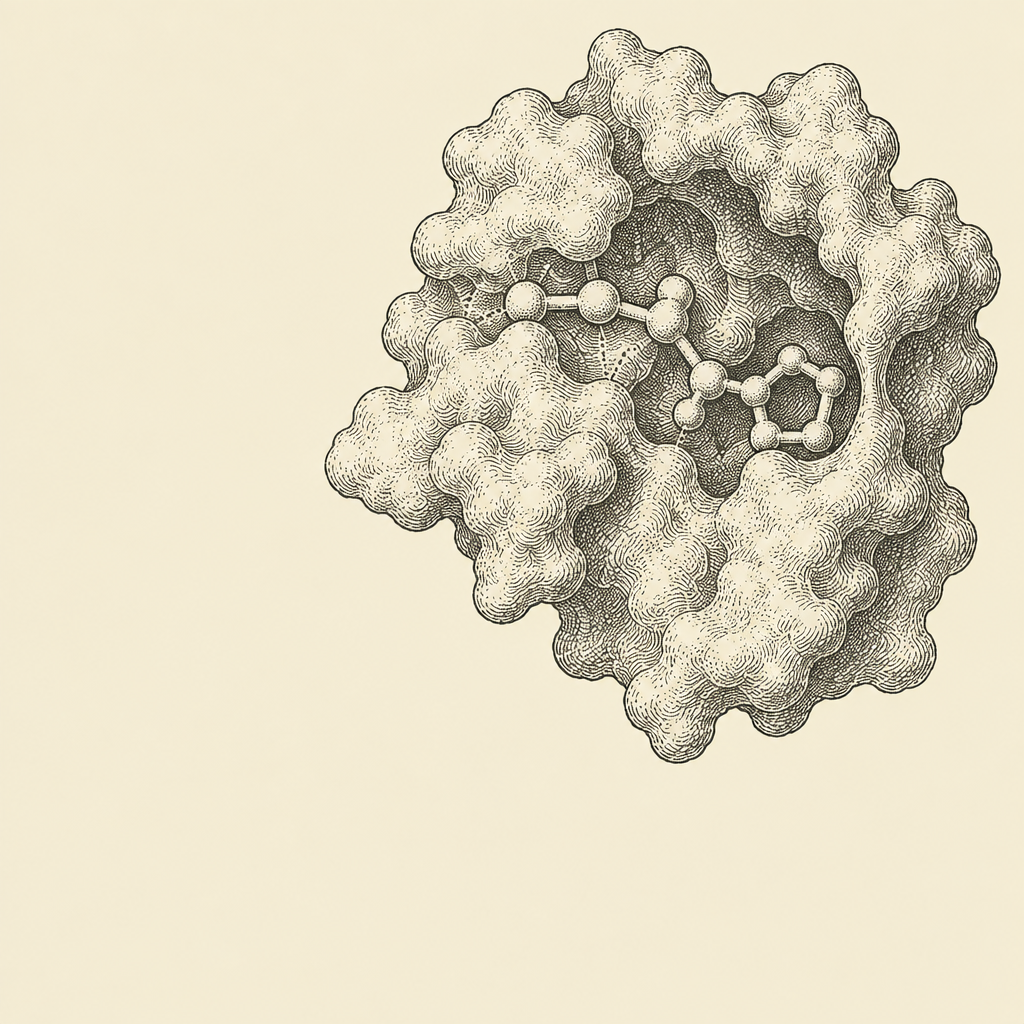
Designed phosphatases get new targets via peptide fusions generated by protein language models, in a bioRxiv preprint from L. Hong. PepRePs points generative sequence design at induced-proximity enzymology: redirecting a phosphatase to strip phosphates from a chosen protein, the dephosphorylation counterpart to targeted degraders. Generative protein design has concentrated on binders and de novo folds. Aiming it at catalytic redirection opens a modality the field has mostly advanced by screening rather than by sequence generation.

GeneICL learns bulk RNA-seq tasks from examples
GeneICL reads bulk expression tables as a single general model trained across datasets, then picks up new prediction tasks from a handful of examples handed to it at run time rather than being refit per study (in-context learning). Bulk transcriptomics has stayed the workhorse of expression analysis and the place task-specific classifiers get rebuilt from scratch for every cohort. A model that transfers lowers the sample-count floor at which an expression study can support a prediction.
MedZERO lets medical agents keep what they learn
Medical agents accumulate knowledge between cases in MedZERO, which adds verified findings to a growing store instead of resetting each encounter, with controls on what gets retained. Pushes clinical reasoning agents toward improving in deployment, the open question behind every hospital pilot.
Reply with your discoveries. A human reads them. Forward freely.
|