
Who gets to run a self-driving lab

-
Nº CXII
- Date
- 02 Oct 2026
- Issue
- 112
- Stories
- Six
- Editor
- ARC
A lab you log into, a binder built atom-first, and a model that picks its own problems.
Cloud biofoundry runs experiments without an on-site lab

A cloud biofoundry runs biology experiments on its own, per a new bioRxiv preprint describing an AI-driven robotic facility that researchers reach over the network instead of building on site. Biofoundries automate the build-and-test half of biological design; putting one behind a cloud interface and an AI planner closes the loop without anyone moving plates between steps. Self-driving labs have so far been single-site showpieces, owned and operated by the group that built them. Delivering autonomous experimentation as a service changes who can run closed-loop biology at all, and what a wet-lab budget has to cover to get there.
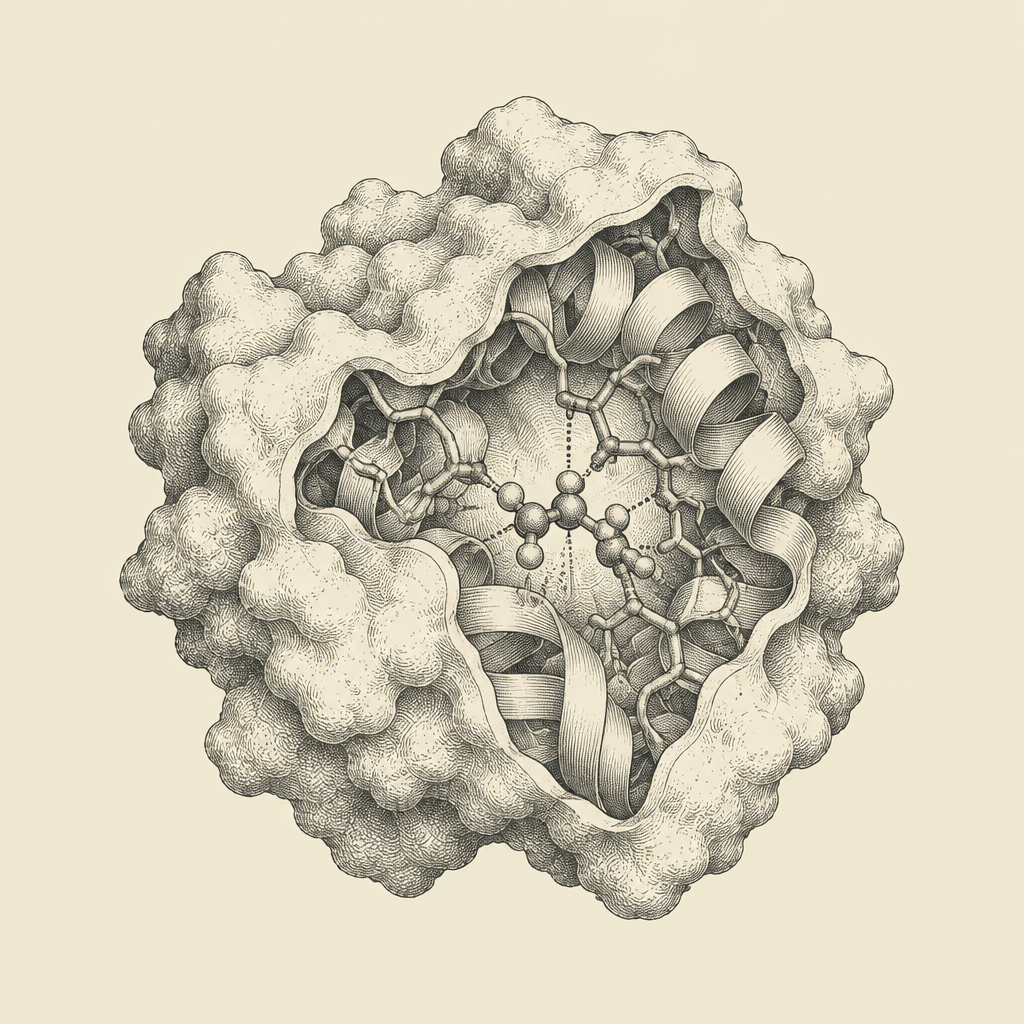
CODesign builds protein binders atom by atom
CODesign co-designs binders at all-atom resolution, producing a candidate's sequence and full side-chain geometry together rather than threading a sequence onto a fixed backbone afterward. The arXiv method enforces consistency at two levels, from the training data through the generation trajectory itself. Binder design is the most closely watched capability frontier in protein AI, and backbone-first pipelines keep losing candidates at the side-chain packing step. All-atom co-design is the route around that bottleneck, which is why each shipped method moves the argument over real-world hit rates.
Anthropic describes letting Claude pick its own problems
Anthropic published an account of what changed when a physicist on staff stopped pushing Claude at the problems he already had and went looking for ones shaped to what the model does well. Out of that came BootLoops, a toolkit for exact calculations in quantitative science, which he has been applying across fields alongside domain experts. The reframing travels further than the toolkit does: quantitative biology has its own exact-calculation corners, and the same habit of handing models the problems people picked first.
Agent workflow cuts seven ageing hypotheses to one
A gated agentic workflow narrowed seven combination hypotheses for healthy-ageing interventions down to one testable interaction, passing them through quantitative systems pharmacology models with approval gates between stages. Gating is what keeps hypothesis-generating agents useful in pharmacology, where the failure mode is plausible output nobody can test.
Review maps the gaps in clinical reasoning rubrics
Clinical-reasoning rubrics get audited in a new arXiv review that maps which scoring schemes exist, what they fail to measure, and which ones need combining. Medical-LLM evaluation currently runs on per-group checklists, and a shared rubric is the precondition for comparing any two claims at all.
Anthropic warns GLM-5.3 writes exploits without safeguards
GLM-5.3 builds end-to-end cyber exploits autonomously, Anthropic reports, and was released without the misuse safeguards other frontier models carry. Biology's dual-use release-norm debate has run mostly on hypotheticals; it now has a concrete precedent from the domain next door.
Reply with your discoveries. A human reads them. Forward freely.
|